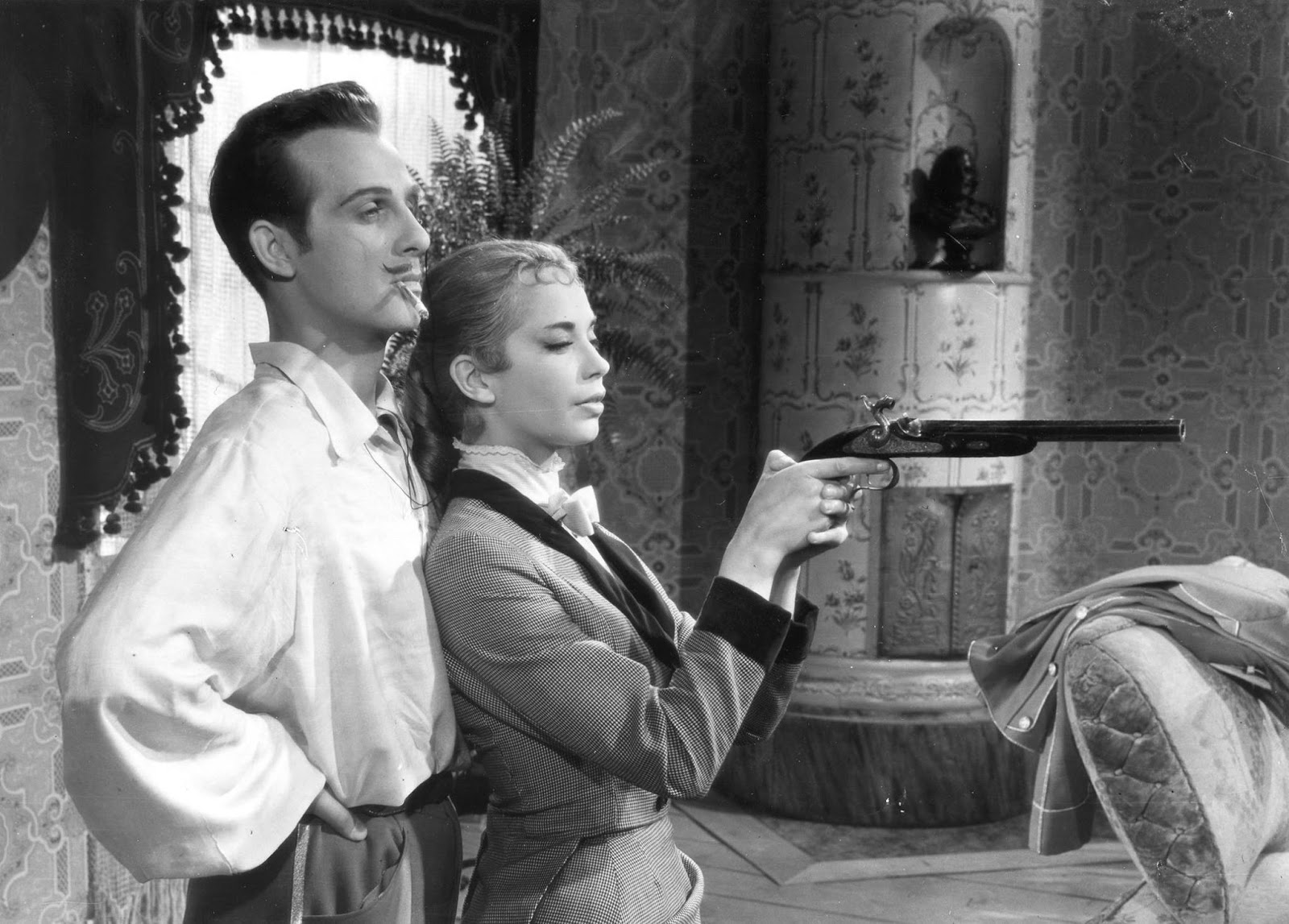
If you read my blogs you may be aware that I am an avid TCM watcher. This month has been especially great for me, because on every Wednesday and Friday the channel is paying tribute to one of my favorite filmmakers, Alfred Hitchcock. With this I want to take some time to talk about one When talking about the films of Alfred Hitchcock Mr. and Mrs. Smith is hardly ever mentioned, and sometimes when it is glanced over as one of Hitch's weakest films. Honestly I disagree with this strongly. It may not be Vertigo or North By Northwest, but it is a very delightful movie that should get more attention.
People familiar with Alfred Hitchcock only as the master of suspense, will probably be very surprised by this film. This is because this film is a screwball comedy, not a suspense movie. Hitchcock would later say in the book long interview with François Truffaut that he did this movie as a favor to Carole Lombard (who plays the lead female character in this movie). However some RKO (the studio this was made for) files state that Hitch personally sought out this film to direct. This would be one of the very few Alfred Hitchcock films in which Hitchcock would not play a huge role in the writing of.
Despite all this though Hitchcock put a lot of effort into the direction of this film. Scenes like the amusement park ride or Mr. Smith (played by Robert Montgomery) and his friend Jeff (played by Gene Raymond) walk opposite directions out the apartment no longer friends are expertly directed. Visually this film is just a treat to look at. The one scene not directed by Hitch was his cameo. This scene was directed by the film's star Carol Lombard, who made Hitch do many retakes.
The direction is not the only thing great about this film. Though not every joke works, the ones that do are very funny. The scene were Jeff is drunk, the amusement park ride, and two disastrous dinner dates are very funny. The love story is quite believable. You constantly believe they love each other no matter what. This movie actually holds up extremely well among many of the great screwball comedies, as there is just so much to enjoy here. This proves Hitchcock was not only a great suspense director, but an amazing director of all types of films, and one of the greatest filmmakers period.
This was Hitchcock's third movie made in Hollywood. The two before this were Rebecca and Foreign Correspondent. Hitch started his career making films in Britain (starting in 1922), and made many great films there. He moved to Hollywood in 1939, after signing a contract with David O. Selznick, the head of 20th Century Fox. However the relationship between the two was not exactly always on good terms and so he soon began making films at other Hollywood studios (such as this film).
Mr. and Mrs. Smith was very popular with audiences. However many critics were not so pleased with the film and considered it below the quality of Hitch's previous American films.
The two main stars of this film would later reprise their roles for radio however not together. Carol Lombard would reprise the role for the Lux Radio Theater show later the year this film was released. Robert Montgomery would reprise the role in 1949 for the Screen Directors Playhouse show.
After this film Carol Lombard would only appear in one more film. That would be Ernest Lubich's To Be or Not to Be released in 1942. She would end up dying in a plane crash in early 1942 while participating in a war bond drive for World War 2.
For the record this film has nothing to do with the 2005 movie baring the same name.
-Michael J. Ruhland
Resourses Used
http://www.tcm.com/tcmdb/title/1693/Mr-and-Mrs-Smith/articles.html
Truffaut/Hitchcock by François Truffaut and Alfred Hitchcock.
Thursday, July 13, 2017
Saturday, June 24, 2017
Grandma's Boy (1922)
Like Harold Lloyd's first feature film (A Sailor-Made Man), Grandma's Boy was not intended as a feature but rather as a short film. However as the making went on, the short would grow in length until it was actually a feature. The movie would be directed by Fred Newmeyer, who had directed A Sailor-Made Man and would continue to be one of Harold's main directors for most of his silent film career.
Though he never received writing credit on a movie, Harold Lloyd had much to do with the stories of most of his films. This was no exception in fact the idea came from Harold Lloyd himself. Originally this movie had much less laughs in it than most Harold Lloyd films had up to this time. Producer Hal Roach was not happy about this and asked Harold to add more jokes and he did. Harold would say that this was the best of his films and remained very proud of it.
Harold (played by Harold Lloyd) is a shy guy and finds it hard to stand up for himself. He loves his girlfriend (played by Mildred Davis (who would later marry Harold Lloyd)), but has never asked her to marry him, out of fear. Things get worse for Harold when a dangerous tramp (played by Dick Sutherland) is on the loose and the sheriff starts deputizing citizens to take care of this tramp. Harold becomes deputized but gets scared and hides in his room. However Harold's kindly grandmother (played by Anna Townsend) knows that all her grandson needs is self confidence. Therefore she tells Harold a story of how his grandfather (also played by Harold Lloyd) overcame his lack of self confidence and Harold is now ready to capture the tramp.
This is a fantastic movie. I agree with Harold completely when he said this would also work as a drama. However the movie is still really funny. Nearly every joke works great. Despite these jokes being added later, it never feels like that was the case. They are not only funny, but fit into and complement the storyline perfectly. They feel like they were always planned to be there, because they just come off so naturally. On the drama side this film works great too. Harold is such a naturally sympathetic character. We are on his side from the beginning. Not only do we feel sorry for him, but we also truly believe in him and think he will make it out perfectly. Adding to this is a great sense of visual filmmaking (heavily thanks to cinematographer Walter Lundin). While there were quite a few studios making only comedies at this time, none had such a great understanding of how to use the cinematic medium to its full effect as much as the Hal Roach studios. The comedies from this studio are simply some of the most beautiful looking comedies of the 1920's and 30's.
The movie was a huge success with both audiences and critics. One especially great complement came from Charlie Chaplin who loved the movie. Exhibitors had been hesitant to pay more for this feature than they had for Harold's shorts, the Hal Roach studio put the film in a third run movie house, where it got huge success and exhibitors had no problem paying more for a Harold Lloyd feature from then on.
A year after this film a silent Our Gang short called The Big Show would come out of the Hal Roach studios. In this short the Our Gang kids would put on their own movie show, which included very faithful and elaborate recreations of a few scenes from Grandma's Boy.
-Michael J. Ruhland
Resources Used
http://www.tcm.com/tcmdb/title/410796/Grandma-s-Boy/articles.html
Thursday, June 15, 2017
Meet The Baron (1933)
Like how today movies get made based off TV Shows, back in the 1930's there were movies based off of radio shows. Meet the Baron was based off a comedy radio show about the fictional Baron Munchausen. Jack Pearl, the radio actor for the character was hired here to play the Baron (or at least someone who is believed to be the Baron) for the screen.
This film would be directed by Walter Lang. Walter Lang is a director who is mostly associated with musical films like State Fair, The King and I (the 1956 live action version)and There is No Business Like Show Business. One of the writers for this film was Herman Mankiewicz, who is known by film fans today for co-writing Citizen Kane (he was also the father of All About Eve director Joseph Mankiewicz and grandfather of TCM host Ben Mankiewicz). One interesting thing in here is that there is a mule named Rosebud in this. I am not saying this film would have inspired any of Citizen Kane, but it is still an interesting tidbit. On top of this the film has a great cast including Jimmy Durante, Edna May Oliver and Zasu Pitts. Even some great actors appeared in very small roles such as Lionel Belmore and Leo White.
However what this film is most watched today for is that it includes a group soon to be known as The Three Stooges. At this time they were known as Ted Healy and his Stooges. Ted Healy was originally the boss and leader of the group, yet after some personal problems between them they would separate and the group would become The Three Stooges. Meet the Baron was the first feature film to feature Curly (although he had appeared in some shorts with this team before). Earlier Shemp would appear in these films with Moe, Larry and Ted. However Shemp was not happy with Ted and left the group. Shemp was replaced by his and Moe's younger brother, Curly. However when in 1946 Curly would have a stroke, he would be replaced again by Shemp, who would once again become part of the team. In this film Curly was credited as Jerry Howard, as his real name was Jerome Howard. This is one of the very few times he would be credited as such.
Curly wasn't the only star to have Meet The Baron as a feature film debut. This was the film debut (not just feature) of Lynn Bari, who would star in quite a few B-movies including Return of the Cisco Kid and Hotel For Women.
The story begins with the real Baron (played by Henry Koller)and his two assistants (played by Jack Pearl and Jimmy Durante) traveling through the jungle. The Baron discovers they are low on supplies and leaves his assistants out to die. At this time some explorers find the two assistants and mistake one for the Baron (Jack Pearl)and take him and his friend to the U.SA.. The phony Baron must keep up the facade and not be found out, which only gets more difficult when he is a guest at an all female college and the real baron shows up.
This film is very entertaining, it has a good sense of humor, a great cast and even a great musical number (a rather risqué one too reminding you that this is in fact a pre-code movie). Most of all though this film is just good corny, silly fun.
-Michael J. Ruhland
Resources Used
The Three Stooges: An Illustrated History, From Amalgamated Morons to American Icons by Michael Fleming
Wednesday, May 31, 2017
A Slight Case of Murder (1938)
When in 1931 Little Caesar became a surprisingly huge hit, Edward G. Robinson was cemented as the cinema's most popular and most representative gangster star. However often after that movie Robinson would not just act in serious gangster movies, he also often appeared in comedies that parodied these gangster films. These comedies included movies like The Little Giant, The Whole Town's Talking, Brother Orchid and Larceny Inc.. A Slight Case of Murder is one of those comedies and a really good one as well.
The director of A Slight Case of Murder was Lloyd Bacon, one of the great studio directors of the 1920's, 30's and 40's. While Bacon had been a director (before directing he had been an actor in some of Charlie Chaplin's best short comedies) since the silent era directing short comedies (starting for comedian Lloyd Hamilton and then for comedian producer Mack Sennett), his career really took off in the early talkie era when he started directing feature films for Warner Brothers. During his stay at Warner Brothers, he would become one of that studio's most reliable directors with such great (and diverse) movies as 42nd Street, Marked Woman, Action in the North Atlantic, Footlight Parade and many many more. He would also direct Edward G. Robinson in the comedies Brother Orchid and Larceny Inc.. A Slight Case of Murder was just one of the many great films Lloyd Bacon worked on for Warner Brothers.
During Prohibition Remy Marco (played by Edward G. Robinson) is the king of beer. However when prohibition ends, he decides to go legitimate and sell his beer legally. Since Remy never drinks though he has no idea just how bad his beer is, and now that people can get the good stuff, they have little to no interest in Marco's beer. With the assistance of his wife (played by Jane Bryan), and his gang (played by Allan Jenkins, Edward Brophy and Harold Huber) he tries to keep this business afloat. To add to Remy's troubles when his daughter (played by Ruth Donnelly) returns from school she is engaged to a guy who just got a job as a cop (played by Willard Parker).
This film is a fast paced, laugh out loud funny comedy that never loses its audience's enjoyment. The movie is simply so much fun from start to finish. Edward G. Robinson (as he has in quite a few other movies) proves he is just as good at comedy as he is at crime dramas. Adding heavily to the fun are Remy's Henchmen. Allan Jenkins, Edward Brophy and Harold Huber were in a whole lot of Warner Brothers movies at this time and though they were mostly in supporting roles, they were fantastic in each of these movies, and this movie is no exception. The three have perfect chemistry together and with Robinson and often bring this movie's biggest laughs. By the way my fellow Disney fans probably know Edward Brophy as the voice of Timothy Mouse in Dumbo and my fellow Hanna-Barbera fans might know Allan Jenkins as the voice of Officer Dibble in Top Cat. The whole cast here in fact plays their roles almost perfectly. Adding to this is a very smart and very funny script by Earl Baldwin and Joseph Schrank and expert direction by Lloyd Bacon.
The film was a huge success with both audiences and critics when released. Even though this movie may not be as well remembered as it should be, more people should definitely watch it as it will continue to delight many people today.
-Michael J. Ruhland
Resources Used
http://www.tcm.com/tcmdb/title/90494/A-Slight-Case-of-Murder/articles.html
http://www.imdb.com/title/tt0030764/?ref_=ttfc_fc_tt
Tuesday, May 30, 2017
The Gold Rush (1925)
Charlie Chaplin's little tramp character is probably the most recognizable image of silent cinema. Even many of those who have never seen a film with this character recognize the look of this character and his funny walk. After watching a movie like The Gold Rush, it is not at all hard to see why this character gained such popularity. After many films of the past have dated (heck even some movies from the 1990's and early 2000's have dated, and many of today's films will seem dated not too long in the future), a movie like The Gold Rush never will. This is the type of movie that so many of those who see it (even those who don't usually like silent movies or slapstick comedy), no matter what year it is, no matter how much movies have changed will continue to be enchanted by this movie. It is this that makes The Gold Rush never date, even when much more recent films are already doing so.
The Gold Rush marked Charlie Chaplin's first starring film for United Artists. United Artists was founded in 1919 by D.W. Griffith, Mary Pickford, Douglas Fairbanks and Charlie Chaplin himself. Though Chaplin had been on of the founders of the studio, he was still under contract to make films for First National. In 1923 Chaplin made his first film for Untied Artists a drama that he directed but only appeared as an uncredited cameo (and is very unrecognizable in that cameo). With The Gold Rush he would finally star in an United Artists film.
This film had an odd inspiration for a comedy, it was inspired by the story of The Donner Party, a group of pioneers who were stuck in a snow storm and had to resort to cannibalism. Making comedy out of something tragic or dark is something Charlie Chaplin excelled in as you can see in such films as Easy Street or Monsieur Verdoux.
This film has three of Chaplin's most famous set pieces, the eating of the shoe, the Tramp turning into a chicken and the dance of the dinner rolls. The shoe was made of licorice, and 20 pairs of these shoes were eaten to get the take just right. Mack Swain who would share the shoe with him in the movie, got to the point where he could hardly eat it anymore. In the scene where Big Jim hallucinated the Tramp as a chicken and tried to eat him, Charlie himself was in the chicken costume. Originally a painter was supposed to wear the costume, but Chaplin was not happy with his performance and felt he had to do it himself. This scene would inspire cartoon director Chuck Jones, who would use a similar bit in the 1943 Bugs Bunny cartoon Wackiki Wabbit. The dance of dinner rolls scene was not the first time this skit had been done on film. Roscoe "Fatty" Arbuckle had performed a very similar skit in the 1917 short film The Rough House. However it had never been done better anywhere than in The Gold Rush. All these set pieces are worthy of the praise they get, as all these scenes are fantastic.
Georgia Hale played the part of Georgia. However this part was originally going to be played by Lita Grey. Lita Grey had previously been the angel that Charlie was tempted by in The Kid. However Charlie and Lita had an affair and Lita was now pregnant, and therefore couldn't play the part as she refused to get an abortion. Though The Gold Rush was the only Chaplin film Georgia Hale appeared in, she would be briefly considered to replace Virginia Cheryl in Chaplin's City Lights.
This film is not only really funny, but quite dramatic as well. What is incredible about this movie is that the comedy and the drama work perfectly together. Neither ever gets in the way of the other, and instead they only seem to help each other. Both the comedy and the drama work near perfectly here, and neither ever feels forced. This is something no one else could do as well as Charlie Chaplin, and this film is the perfect example of why. The whole movie is simply a delight to watch and one of Chaplin's best films.
Charlie Chaplin would later rerelease this film in 1942. However in that version he would narrate the movie and cut about a reel from it. While that version is still quite good, to me at least, the 1925 silent version remains the best way to watch this movie.
-Michael J. Ruhland
Resources Used
http://www.tcm.com/tcmdb/title/5779/The-Gold-Rush/articles.html
DVD commentary by Jeffery Vance.
Wednesday, May 24, 2017
Smiles of a Summer Night (1955)
When one thinks of film comedy Ingmar Bergman is usually not the first director who comes to your mind. However he actually made some comedians over his career including The Devil's Eye, Secrets of a Woman and All These Women. However probably the best of his comedies is Smiles of a Summer Night.
Around the time Bergman started making Smiles of a Summer Night, he was in fact very depressed. After a lot of stress making some of his previous movies, he knew he had to make a film just for fun and that film ended up being Smiles of a Summer Night. He would later say at this time he had just two options, "write Smiles of a Summer Night, or kill myself." Fortunately he choose the first option. Bergman would also later say "I thought it was time for a box-office success, and though everyone disagreed with me, I was convinced that this picture would succeed."
This film was heavily by the famous Shakespeare play, A Midsummer Night's Dream. One person who definitely realized that connection was Woody Allen, who would incorporate much of this Bergman film into his 1982 movie, A Midsummer Night's Sex Comedy.
Fredrick (played by Gunnar Bjornstrand) is married to a young woman named Anne (played by Ulla Jacobsson). Despite being married for two years and sharing a bed Anne is still a virgin and this makes Fredrick quite nervous. Fredrick asks a woman who he used to have an affair with, Desiree a beautiful actress (played by Eva Dahlbeck). Desiree still has feels for Fredrick though she is currently the mistress of a solider named Count Malcom (played by Jarl Kulle). Meanwhile Fredrick's son Henrik (played by Bjorn Bjelvenstam) has devoted himself to God, but finds himself quite tempted by the family's maid Petra (played by Harriet Andersson).
This is a sex comedy that is very frank about sex (shockingly so for a 1955 Swedish movie). However it never delves into cheap or easy vulgarity. Rather than this, the humor in the film remains very smart, sophisticated and charming even with its highly sexually nature. The humor also remains very funny throughout. Often making one laugh out loud. The humor is not the only great thing about this film as the performances are all fantastic and Gunnar Fischer's cinematography is quite lovely to look at. This all comes together to create a film that is smart, sexy, funny and just all around fantastic.
The film was huge success all over the world. Because the film earned so much money Svensk Filmindustri, the studio Bergman was working for would give Bergman strong control over his future films. The studio was so happy with this film they submitted it to the Cannes Film Festival. However Bergman was unaware of that it was even submitted until one day while sitting reading the newspaper he saw that the film was a huge success there.
-Michael J. Ruhland
Resources Used
http://www.tcm.com/tcmdb/title/90563/Smiles-of-a-Summer-Night/articles.html
Friday, May 19, 2017
Monkey Business (1931)
Though most people site Duck Soup or A Night at the Opera as their favorite Marx Brothers movie (I love both those movies a lot by the way), my personal favorite is Monkey Business. This film is so fast paced and full of jokes, yet almost every single one of them hits perfectly. This movie features the great skit where all four of the brothers try to inmate Maurice Chevalier (which has to rank as among the funniest skits in movie history), Groucho and Thelma Todd have great chemistry (she would only appear in one more Marx Brothers movie, Horsefeathers), there is a brilliantly surreal sequence in which Harpo interrupts a Punch and Judy show that doesn't seem to have any puppeteers and it has one of my favorite Groucho lines "Madam, you're making history. In fact, you're making me, and I wish you'd keep my hands to yourself". Also helping make this film great is that Zeppo is actually given some good scenes here and he pulls them off very well (making me wish he was given more to do in other Marx Brothers movies).
Monkey Business was the brothers' third movie and their first one written specificly for the screen. Their two previous films, The Coconuts and Animal Crackers had been two of the brothers' successes on Broadway. Since these were hits on Broadway, it was assumed they would probably have success with them on the movie screen and that ended up being correct. Those movies were huge successes.
Writer S.J. Perelman had written a book called Dawn Ginsbergh's Revenge, which Groucho really liked. Groucho sent a complimentary letter to Perelman and asked to meet him backstage (the brothers were still on Broadway at this time), and Perelman said he would enjoy writing for the brothers. He was assigned to co-write (with W.B. Johnstone, who wrote the brothers' first stage success, I'll Say It Is) a radio script for the brothers, this would end up not happening because of the difficultly of the non-speaking Harpo being on radio. However the basic story idea of the Marxes as stowaways became the basis for this film in which Perelman would be a writer. However despite Groucho being impressed with Perelman' book, he wasn't as impressed with the script. His response can be summed up in two words "It stinks". Groucho often stated that the brothers in reality adlibbed nearly all of the funniest jokes in this movie and the next film Horsefeathers (also written by Perelman) and little of what Perelman wrote ended up in either script. The director of both films, Norman Z. McLeod, agreed that there was a lot of adlibbing on both the movies, and McLeod felt these adlibs were funnier than anything in the script. Groucho would later state about Perelman "...he is a great writer with a brilliant comic mind that didn't always mesh well with the lunacies of the Marx Brothers."
This film has inspired debate among Marx Brothers fans. It begins with a man telling the captain that there are four stowaways on the ship, but no one has seen them. When asked how he knows there are four, he states that they were singing Sweet Adline. Then the film cuts to four barrels and we hear Sweet Adline being sung, and after the song the Marx Brothers pop out of each. Now the debate has to do with whether there are three or four voices singing and if we actually hear Harpo's voice. Unfortunately I do not know the answer to this.
This film was not surprisingly a hit at both the box office and with critics. Now the story is simply an excuse for comedy, and it is impossible to properly analyze why the Marx Brothers are so funny. So just watch the movie for yourself and laugh yourself silly, you won't regret it.
-Michael J. Ruhland
Resources Used
http://www.tcm.com/this-month/article/290225%7C86548/Monkey-Business.html
Wednesday, April 19, 2017
Happy 87th Birthday to Looney Tunes and Bosko
87 years ago today the very first Looney Tunes cartoon Sinkin in the Bathtub was released. This also marked the first appearance of Bosko on cinema screens. While it is true that he had appeared in 1929's Bosko the Talk-ink Kid before, that was just a pilot film and only shown to distributors for the cartoons. Sinking in the Bathtub marks his real birthday. So to celebrate the greatest cartoon series ever made, and the birthday of the first Looney Tunes star, today we are going to look at three Bosko cartoons.
The first we will look at is the second Bosko cartoon and second Looney Tune all together, 1930's Congo Jazz. In Sinkin in the Bathtub Bosko clearly had a stereotypical black voice (provided by animator Max Maxwell), However with this film he was made to sound more like Disney's star character Mickey Mouse with a high pitched voice (now provided by Johnny Murray). A lot of stereotypical black dialogue was originally written for this cartoon but never used. This is not were the similarities to Disney end as this cartoon bares a strong rebalance to the 1929 Mickey Mouse cartoon Jungle Rythym. Despite all this it remains a very entertaining picture so directed by Hugh Harmon and Rudolph Ising here is Congo Jazz.
Hugh Harmon and Rudolph Ising were the creators of Bosko and they also co-directed is earliest films. However when Looney Tunes sister series Merrie Melodies was created, Ising took over directing that series while Hugh Harmon directed the Looney Tunes (all the Bosko films) mostly by himself. This next cartoon took place after that happened and is also one of Bosko's best films. This cartoon shows Bosko in a much more violently funny cartoon. That shows a brief glimpse of what Looney Tunes would later become, despite the still obvious Disney influence. This cartoon bears a passing rebalance to another Disney cartoon, this time Walt's 1927 Oswald the Lucky Rabbit cartoon, Great Guns (for which Harmon was an animator on). So from 1931 here is Bosko the Doughboy.
Last but not least is another one of Bosko's best outings. This cartoon featured another addition to make Bosko resemble more and more Mickey Mouse. That was Bruno the dog, obviously inspired by Pluto. This was Bruno second appearance in a Looney Tunes as he had previously appeared in Bosko's Fox Hunt (released the previous year). This film features some sentimentality, which would figure more into Harmon's MGM work. It is also a film of great energy and a joy to watch. So from 1932 and directed by Hugh Harmon, here is Big Hearted Bosko.
The first we will look at is the second Bosko cartoon and second Looney Tune all together, 1930's Congo Jazz. In Sinkin in the Bathtub Bosko clearly had a stereotypical black voice (provided by animator Max Maxwell), However with this film he was made to sound more like Disney's star character Mickey Mouse with a high pitched voice (now provided by Johnny Murray). A lot of stereotypical black dialogue was originally written for this cartoon but never used. This is not were the similarities to Disney end as this cartoon bares a strong rebalance to the 1929 Mickey Mouse cartoon Jungle Rythym. Despite all this it remains a very entertaining picture so directed by Hugh Harmon and Rudolph Ising here is Congo Jazz.
While
these films were quite successful Hugh Harmon (and to a lesser extent Rudolph
Ising) was not happy about the budgets they were made on. He simply wanted more
money to make these cartoons. However Leon Schlesinger refused to raise the
films budget. After this both Hugh Harmon and Rudolph Ising left Warner
Brothers in mid-1933. However learning from their former boss, Walt Disney,
losing the rights to Oswald the Lucky Rabbit, Harmon and Ising made sure they
owned the rights to the character of Bosko. Because of this the Looney Tunes series no
longer had any star characters (which would lead to the creation of the beloved characters we associate with Looney Tunes today) When at
MGM Harmon and Ising created a series called Happy Harmonies. Though this series
focused mostly on one shot characters and stories, a few Bosko cartoons were
made for it.
-Michael J. Ruhland
Resources Used
Hollywood Cartoons: American Animation in its Golden Age by Michael Barrier
Of Mice and Magic: A History of American Animated Cartoons by Leonard Maltin
Monday, April 17, 2017
Happy 80th Birthday to Daffy Duck
80 years ago today one of the world's greatest cartoon characters made his first appearance on movie screens. This character was Daffy Duck and his film debut was 1937's Porky's Duck Hunt. Before this cartoon movie audiences had never seen a cartoon character as wild, crazy and energetic as Daffy. Naturally audiences wanted more Daffy, and of course they got more of him. Today to celebrate his birthday we are going to look at three classic Daffy Duck cartoons.
Our first film is Daffy Duckaroo directed by Norm McCabe. Norm McCabe is one of the most forgotten directors of Looney Tunes cartoons. Part of this is that he spent such a short time as a director. Before becoming a director McCabe had been one of Bob Clampett's main animators, when Clampett was still doing black and white Looney Tunes. When in 1942 Bob Clampett got promoted to doing color Merrie Melodie cartoons, Norm McCabe took over his black and white Looney Tunes unit. However in 1943 director Frank Tashlin had returned to Warner Brothers after leaving it to work at Disney and Colombia. Tashlin was given charge of this unit and McCabe was no longer a director. However Norm McCabe would later return to be director as he directed various TV cartoons. Included among his TV work is a segment in the Tiny Toons Adventures episode Pledge Week entitled Lifeguard Lunacy. Another reason is that you will not see his shorts on Cartoon Network or Boomerang, because they are in black and white, they contain many references to World War Two and they feature a lot of racial stereotypes. Despite all this though his cartoons had their own unique personality all to themselves, and were often very good films. One of the best examples of his work is the following cartoon so from 1942, here is The Daffy Duckaroo.
Next up comes one of the most pure energetic cartoons ever made. This is Friz Freleng's Yankee Doodle Daffy. Despite the title this is not a patriotic cartoon even though there were plenty of those coming out of the Looney Tunes series at this time. The title rather alludes to the famous Michael Crtiz live action feature that had come out the previous year. That film featured James Cagney playing George M. Cohan, who was one of the all time great entertainers. This film on the other hand features Daffy as a talent manager trying to promote his latest sensation, Sleepy Lagoon to a less than enthusiastic Porky Pig, who in this cartoon is president of Smeller Productions (a talent agency). Friz Freleng was a master of comic timing and that shows perfectly here as the film is paced perfectly. It may never really slow down, but never does this fast pace become distracting. So from 1943 here is Yankee Doddle Daffy.
Lastly comes another pairing of Daffy and Porky, this time in a black and white Looney Tune directed by Bob Clampett called Scalp Trouble. Clampett was one of the most energetic and wild directors in the history of cartoons. Since Daffy Duck is one of the most energetic and wild cartoon characters of all time they made a perfect team. The writing credit for this cartoon was given to Ernest Gee. Gee was one of Clampett's friends from high school. He wasn't a writer in the traditional sense. Rather than actually write out a story on a script or storyboard, Gee would join Clampett for a game of Ping Pong. As they played they talked about the cartoon and doing it this way caused him to come up with ideas and gags quickly. Scalp Trouble would be remade by Friz Freleng as a color Merrie Melodie called Slightly Daffy in 1944. So from 1939 here is Scalp Trouble.
-Michael J. Ruhland
Resources Used
Of Mice and Magic: A History of American Animated Cartoons by Leonard Maltin
Hollywood Cartoons: American Animation in its Golden Age by Michael Barrier
Our first film is Daffy Duckaroo directed by Norm McCabe. Norm McCabe is one of the most forgotten directors of Looney Tunes cartoons. Part of this is that he spent such a short time as a director. Before becoming a director McCabe had been one of Bob Clampett's main animators, when Clampett was still doing black and white Looney Tunes. When in 1942 Bob Clampett got promoted to doing color Merrie Melodie cartoons, Norm McCabe took over his black and white Looney Tunes unit. However in 1943 director Frank Tashlin had returned to Warner Brothers after leaving it to work at Disney and Colombia. Tashlin was given charge of this unit and McCabe was no longer a director. However Norm McCabe would later return to be director as he directed various TV cartoons. Included among his TV work is a segment in the Tiny Toons Adventures episode Pledge Week entitled Lifeguard Lunacy. Another reason is that you will not see his shorts on Cartoon Network or Boomerang, because they are in black and white, they contain many references to World War Two and they feature a lot of racial stereotypes. Despite all this though his cartoons had their own unique personality all to themselves, and were often very good films. One of the best examples of his work is the following cartoon so from 1942, here is The Daffy Duckaroo.
Resources Used
Of Mice and Magic: A History of American Animated Cartoons by Leonard Maltin
Hollywood Cartoons: American Animation in its Golden Age by Michael Barrier
Wednesday, January 18, 2017
Happy 125th Birthday Oliver Hardy
Anyone who reads my blogs, knows that I love Laurel and Hardy, and why not? They are hilarious. And on Oliver Hardy's 125th Birthday of course I have to write about some films he appears in.
The first film we are going to look at is called The Paperhanger's Helper (also known as Stick Around) and was before Oliver Hardy teamed up with Stan Laurel. In this film he is teamed up with a forgotten actor named Bobby Ray. The relationship and humor in this film however are very reminiscent of the work he would do with Stan Laurel. There are some distinct differences though. Oliver Hardy plays a mean character here than he would later and Bobby Ray, while talented doesn't have the charisma of Stan. Despite this however the film is very funny, and a delight to watch. So from 1925 and directed by Ted Burnsten, here is The Paperhanger's Helper.
Next up we are going to look at the first film where Stan and Ollie were teamed, Duck Soup (the supervising director was Leo McCarey who would direct the better know Marx Brother's film of the same name). Unlike most comedy teams of the time Laurel and Hardy teamed up on film, instead of some where else, first. Though they had appeared together first in 1921 with The Lucky Do, they were not a team until this film. Interestingly the film was originally going to star Stan Laurel and Syd Crossley. However for unknown reasons Syd did not appear in the film and was replaced by Oliver Hardy. The story of this short was based off a skit written by a British Music Hall comedian named Arthur Jefferson, who just happened to be Stan's father. This story would be used again for the teams talkie short Another Fine Mess. This is a delightful film and it is easy to see why the team would soon become so popular with audiences. It is also worth noting a first the studio didn't realize what it had as Stan and Ollie would make quite a few shorts separately and also both appear in films where they shared very little footage. So from 1927 and directed by Fred Guiol (with supervising direction by Leo McCarey) here is Duck Soup.
Last but not least is one of my favorite Laurel and Hardy shorts, Their First Mistake. This short may be one of the funniest live action short subjects ever made. Along with Stan and Ollie also appearing in this film was Mae Busch (in a returning role as Mrs. Hardy (she had already played Ollie's wife in Unaccustomed As I Am, and would later return to the role for Sons of the Desert and The Bohemian Girl)) and Billy Gilbert (known to my fellow Disney lovers as the voice of Sneezy in Snow White and the Seven Dwarves), both giving great performances. Stan Laurel was known for improvising and here he improvised so much that the film went over schedule and budget that the ending was never filmed, leaving the short without a proper ending. However this is not a big deal as the film is so funny, I don't care about the lack of an ending. So from 1932 and directed by George Marshall, here is Their First Mistake.
https://www.youtube.com/watch?v=f-yDwTL3YiI
-Michael J. Ruhland
The first film we are going to look at is called The Paperhanger's Helper (also known as Stick Around) and was before Oliver Hardy teamed up with Stan Laurel. In this film he is teamed up with a forgotten actor named Bobby Ray. The relationship and humor in this film however are very reminiscent of the work he would do with Stan Laurel. There are some distinct differences though. Oliver Hardy plays a mean character here than he would later and Bobby Ray, while talented doesn't have the charisma of Stan. Despite this however the film is very funny, and a delight to watch. So from 1925 and directed by Ted Burnsten, here is The Paperhanger's Helper.
Last but not least is one of my favorite Laurel and Hardy shorts, Their First Mistake. This short may be one of the funniest live action short subjects ever made. Along with Stan and Ollie also appearing in this film was Mae Busch (in a returning role as Mrs. Hardy (she had already played Ollie's wife in Unaccustomed As I Am, and would later return to the role for Sons of the Desert and The Bohemian Girl)) and Billy Gilbert (known to my fellow Disney lovers as the voice of Sneezy in Snow White and the Seven Dwarves), both giving great performances. Stan Laurel was known for improvising and here he improvised so much that the film went over schedule and budget that the ending was never filmed, leaving the short without a proper ending. However this is not a big deal as the film is so funny, I don't care about the lack of an ending. So from 1932 and directed by George Marshall, here is Their First Mistake.
https://www.youtube.com/watch?v=f-yDwTL3YiI
-Michael J. Ruhland
Monday, January 16, 2017
Keystone Karnival #2
You know what time it is. Of course you do... It's Keystone Time. Yep we are going to look at some more shorts from the Keystone studio.
First up is A Busy Day, a film staring the biggest name to come out of Keystone, Charlie Chaplin. While Charlie would later leave Keystone and go to make some of the best comedy films of all time, he got his start at the Keystone studio. He worked at the studio only for the year 1914, however a lot happened during this year. He had his first film role, he adopted the Tramp costume, he started directing his own films and he acted in Tillie's Punctured Romance (the first known feature length comedy). When making A Busy Day, he had not begun directing yet, instead this film is directed by the head of Keystone Studios himself, Mack Sennett. Also while he had appeared in the Tramp costume by this time (starting with Kid Auto Races in Venice), he had not truly adopted the costume and the character was far from realized. In this film he does not appear in that costume but rather in drag, actually playing a woman, with Mack Swain (who would later play Big Jim McCay in Chaplin's The Gold Rush). While this is far from one of Charlie Chaplin's best films, it is an entertaining little romp, and a fascinating look into the early career of one of comedy film's greatest masters.
https://www.youtube.com/watch?v=_gfMWt1oj7c
Probably the best teaming of stars at Keystone was the teaming of Mabel Normand and Fatty "Roscoe" Arbuckle. The two had perfect chemistry together and it was always a joy seeing them share the screen. Up next is my favorite pairing of the two, Fatty and Mabel's Simple Life from 1915. This short shows a bit of sweetness in the characters that is unusual in Keystone films, that actually tuned up multiple times in the shorts that teamed these two up. It works in these films because of the talent these two stars had. However this is still a slapstick comedy at heart, featuring much of the typical Keystone sense of humor, and much of it is quite funny. The film was directed by Fatty himself. So enjoy.
https://www.youtube.com/watch?v=1_T80QoRLIs
By the time this last short (1924) was made, the studio had changed it's name to Mack Sennett Comedies. This short stars the studios latest big star, Harry Langdon, who Mack Sennett felt was the greatest comedian he ever worked with. This is one of Harry's best shorts a mini masterpiece called All Night Long. The film was directed by Harry Edwards and written by Arthur Ripley, two of Harry's best collaborators. Despite Frank Capra often times given himself credit for creating Harry's character, this film was done before he ever worked on a film with Harry Langdon, and it is obvious that the character is fully developed here. While hints of Harry's character showed up in earlier films, this is one of the earliest (and arguably the earliest) times that every thing came together perfectly. This film also has the slower pacing and offbeat humor that is shown in Harry's best work. This may be one of the greatest live action short comedies ever made so enjoy, a lot.
https://www.youtube.com/watch?v=4D4kt55ezsE
-Michael J. Ruhland
Wednesday, January 4, 2017
Classic Film Comedy Short Stories #12
It's been a while since I have done one of these. So a quick reminder this is a mixture of trivia and short stories about classic film comedy (1912.-1955). This was inspired by the Animation Antidotes posts on Cartoon research.com to give credit where credit is due.
French cinema and stage legend Sacha Guitry made only one published novel. This novel was adapted by Guiltry himself into his most popular film, The Story of a Cheat (1936). Most of his films were based off his own plays. Another exception to this is his film The Pearls of the Crown (1937). That film was his only story originally written (by himself) to be a movie. Both are fantastic films I highly recommend.
Director Chuck Jones had a set of rules for the coyote and roadrunner cartoons to follow (Roadrunner must stay on the road, No dialogue beyond "Beep Beep", the roadrunner must never hurt the coyote, etc.). However his main writer Michael Maltese was unaware of such rules. Coyote and roadrunner cartoons were the easiest cartoons to make for them, and therefore where often used to fill time when another cartoon was taking a longer time.
Laurel and Hardy made foreign language versions of their own films, by reading the words written phonetically off-screen. Some of these were in fact longer than the original English language version (with extra scenes added) and some combined multiple shorts together. Though it is often written that Pardon Us was the team's first feature (it was their first English language one) the first of their films to reach feature length (at least that I'm aware of) was Noche De Duendes (1930), a Spanish language version of The Laurel and Hardy Murder Case (1930) with scenes from Berthmarks added. This film was 49 minutes, and a feature is any film over 40 minutes.
When working on the film The Kid (1921), Charlie Chaplin would take Jackie Coogan (who played the title character) to an amusement park, for pony rides or whatever every Sunday. The two remained close for many years.
-Michael J. Ruhland
Wednesday, July 27, 2016
Happy 76th Birthday Bugs Bunny
76 years ago today Bugs Bunny first hopped onto movie screens. Since this he has become one of the most famous and beloved cartoon stars in the world. To celebrate his birthday today we are going to look at some great Bugs Bunny shorts.We are going to start with a classic 1943 cartoon from director Robert Clampett. This film is Falling Hare, and is a short about Bugs fighting a gremlin. The title was originally going to be Bugs Bunny and the Gremlin. However Disney was working on an animated feature called Gremlin Lore (film that would never come to be). Because of this Walt asked if the other Hollywood animation studious could not make cartoons about gremlins. However since this cartoon was already well into production, producer Leon Schlesinger decided instead to change the title to Falling Hare. Similarly another Warner Brothers' cartoon originally going to be titled Gremlins From the Kremlin was renamed Russian Rhapsody. The animators on this film include Robert McKimson, Rod Scribner, Manny Gould, Thomas McKimson, Bill Melendez, Phil Monore and Virgil Ross. This an excellent and very funny cartoon, so enjoy.
The popularity of Bugs will never end nor should it so on with the show this is it...
Thursday, June 16, 2016
Happy 126th Birthday Stan Laurel
Today we give tribute to one of the greatest comic minds in the history of film. That is Stan Laurel, who was born this day in 1890. Stan Laurel is of course most associated with the team of Laurel and Hardy and this is where he did his best film work. The Laurel and Hardy films remain some of the funniest comedies in the history of cinema. They are something that every lover of comedy should watch however he had a quite good career before he teamed up with his longtime screen partner.
This is where are first film comes in. It is Stan's earliest existing film. Though Stan had appeared in films before this, all of those are considered lost. So we are going to look at 1918's Just Rambling Along. This film was directed by Hal Roach, who produced many of Laurel and Hardy's best films. This film is the first time Stan worked with Roach. Look for also appearing in this film Noah Young (the bully in many Harold Lloyd films) and Bud Jamison (who would often times appear with the Three Stooges). It is also worth noting how little this character has to do with Stan Laurel's later character. It would be a while before audiences would first see that character. Also this film doesn't exist in it's entirety and parts are missing but we are lucky to have it at all.
https://www.youtube.com/watch?v=otaFjn7oc3k
Stan Laurel for a short time appeared in a few films of actor/director/writer Larry Semon. What is interesting about this is Oliver Hardy did as well but not at the same time. So the two never worked together on these films. Larry Semon was a very popular comedian during this time. His talents lied heavily in slapstick and stunts, but he often missed when it came to story and characters. Therefore his film output was not very consistent. However this film is one of Semon's best. So also from 1918 here is Fraud and Frenzies.
https://www.youtube.com/watch?v=QdikSvgU4TY
Next up comes a classic Laurel and Hardy silent short called That's My Wife. Laurel and Hardy teamed up near the end of the silent era, but their contribution to this art of silent film was great. Such films as this, Wrong Again, Big Business and Two Tars are absolute classics of silent comedy. This film was directed by Lloyd French, whose whole career as a director was mostly spent in short subjects (his only feature work was as an uncredited co-director on a Laurel and Hardy feature called Pack Up Your Troubles). He did his best work with Laurel and Hardy directing such classics as Dirty Work and Busy Bodies. One of the writers of this film was Leo McCarey who would later direct such classics as Duck Soup and The Awful Truth. McCarey is also often given credit for the idea of teaming Stan and Ollie. The cinematographer for this film was George Stevens, who would later direct such classic as The More The Merrier, The Dairy of Anne Frank and Shane. This is a fantastic short and I know you will enjoy.
https://www.youtube.com/watch?v=c6wgHSKvIzk
Next up comes another classic Laurel and Hardy short. The next film is Brats. This film was directed by James Parrott, who was the brother to comedian Charlie Chase. This film features no one but Laurel and Hardy. Though this was done before in Early to Bed, it was very rare. In this film they played their own kids as well as their regular characters. Like many of Laurel and Hardy's talkies multiple versions of this film were made. A silent version, an English langue talkie version (the one you are about to see) and foreign langue versions (for which Laurel and Hardy themselves read off of cue cards with the dialogue written phonetically). This is a great short so enjoy.
https://www.youtube.com/watch?v=-mxjmf_mIuw
-Michael J. Ruhland
Thursday, March 17, 2016
Classic Film Comedy Short Stories #11
Moe Howard's wife Helen suggested the story line for Hoi Polloi, one of the three stooges best films. However when she was asked if she would rather have money or screen credit she took the money.
In Fredrico Fellini's The White Sheik, the director's excellent first solo directorial feature, a star of one of Fellini's great coming classics showed up in a small cameo. This was the character Cabiria (played by the director's wife Guilietta Masina) who would later become the main character of The Nights of Cabiria, one of Fellini's many master pieces. It is also with noting that some of Nino Rota's musical score for the film would later be used in Fellini's La Starda (La Starda is one of my favorite movies ever made which makes this connection all the cooler for me).
Buster Keaton's first feature Three Ages was made so that it could be cut up into three shorts if it did not do well, to help make back some money. However the film was a hit and Buster would make more ambitious features in the future.
Lost in Alaska with Abbott and Costello was the first film in which composer Henri Mancini worked. He would later go on to immortality for composing the Pink Panther theme.
Though Charlie Chaplin's The Circus was released in 1928, ideas for the film had been going around Charlie's head since 1920.
Edna Purviance one of Charlie Chaplin's earliest leading ladies stayed on Chaplin's payroll well after she retired. Charlie had great respect for Edna and even directed the drama film A Woman of Paris, her first staring role and produced her A Woman of the Sea, her only other staring role. Unfortunately A Woman of the Sea is now a lost film, and A Woman of Paris is an underrated classic.
A 1921 silent film called Humor Risk was the film debut of The Marx Brothers, unfortunately this is a lost film today.
-Michael J. Ruhland
Wednesday, March 16, 2016
Keystone Karnival #1
It's time to take a look at one of the most successful studios of the silent era, The Keystone Studio, and it's films.
Our first film today is The Water Nymph. Released in 1912, this was the first film the studio released. Mack Sennett started his career at the Biograph Studio, a studio founded by D.W. Griffith himself. D.W. Griffith never understood comedy, and because of this Mack Sennett never fully got to be himself as a filmmaker. This is one of the main reasons Mack Sennett founded the Keystone Studio. Sennett directed this film himself, it was somewhat a remake of a film he had made at Biograph in 1911 called The Diving Girl. However The Water Nymph is much rowdier and more comedic than the previous short. This film stars Sennett, Mabel Normand (who was also in The Diving Girl), and Ford Sterling. The beautiful and talented Mabel Normand in her one piece bathing suit, would later give birth to Mack Sennett's bathing beauties, a later staple of Keystone films. It is hard to understand today, why this film was so revolutionary, but 1912 audiences had never seen such a mixture of slapstick and sex (tame compared to modern films) on the movie screen before. However this does not stop it from being quite entertaining still.
Many stars got their start in films at the Keystone studios, including W.C. Feilds, Fatty Arbuckle, Ben Trupin, Harry Langdon, Harold Lloyd, Marie Dressler and Charlie Chaplin. One of Chaplin's best films from his time at Keystone was our next short, Dough and Dynamite. Released in 1914, Chaplin's first year in films, it is obvious that his own style of comedy was already becoming evident. This film has no trouble taking it's time and slowing down the pace to make the slapstick even funnier, something that was not evident at all in his first few films at Keystone. This film was directed by Charlie Chaplin, and written by Mack Sennett. Chaplin did not start off directing his own films, but he became increasing unhappy with his directors to the point where he asked if he could direct his own films. After this he would very rarely star in any film that wasn't directed by himself.
Next we are going to look at an early film for a group that Keystone is highly associated with
Keystone, and this was the Keystone Cops. The Keystone Cops first appearance had been in a 1912 film called Hoffmeyer's Legacy, but this film is still often called their first film, and it was the one that popularized the team. Despite popular belief the cops were hardly ever the stars of their films. Like Mighty Mouse would later they usually didn't even appear until near the end of the films. This film's real star is Mabel Normand instead. The lineup for the Keystone Cops would often change from film to film, here they are played by Fred Mace, Charles Avery, Rube Miller, Edgar Kennedy, Jack Leonard, and Fred Happ. This film is directed by Henry Lehrman who was one of the most prolific Keystone directors. So from 1913, here is Bangville Police.
Our last film tonight is one of the classic Mack Sennett produced shorts staring Harry Langdon. It is Soldier Man from 1926. Langdon was in his prime at this time, and he already had his trusty crew behind him. This crew included director, Harry Edwards, and writers Arthur Ripley and Frank Capra (yes the Frank Capra who later directed It's a Wonderful Life and Mr. Smith Goes to Washington). Also playing a supporting role is someone who would be very familiar to my fellow Three Stooges watchers, actor Vernon Dent, who appeared in quite a few films with Langdon at this time. What is also very interesting about this film is that it's opening scenes are quite similar with those that opened the latter Laurel and Hardy feature Blockheads. What makes that interesting is that Harry Langdon would be a writer for that film. Anyway this is a very funny short that shows just how great the team of Langon, Edwards, Capra, and Ripley could be at their best.
http://www.dailymotion.com/video/x23dghg_soldier-man-1926-harry-langdon-harry-edwards_shortfilms
-Michael J. Ruhland
Friday, November 20, 2015
Classic Film Comedy Short Stories #10
The film Smiles of a Summer Night was entered into the Cannes Film Festival without it's director Ingmar Bergman knowing. He found out is was entered when he read read the news papers talking about it.
Despite Universal being well known for horror films, the only Jekyll and Hyde film to come out of the studio was Abbott and Costello Meet Dr. Jekyll and Mr. Hyde.
The Academy Awards state that to win an award a film has to play in Los Angles. Because of controversy surrounding director/star/writer/producer Charlie Chaplin during the Cold War Era, his 1952 film Limelight, was not released in L.A. until 1972. Because of this it is the only film to receive an academy award 20 years after it was completed. It received an award for it's musical score.
Animation legend Walter Lantz (Woody Woodpecker, Andy Panda, Chilly Willy) wanted to make a combination live action/animation feature film with the comedy team Abbott and Costello, since they were both working for Universal. Unfortunately this never came to be.
For the scene in Charlie Chaplin's The Gold Rush where the little Tramp seeming turns into a chicken before Big Jim McKay's (Mack Swain's) eyes, a stage hand was supposed to be in the chicken suit. However the stage hand just couldn't move the way Chaplin wanted. So Chaplin himself got into the chicken suit.
In another famous scene from Chaplin's The Gold Rush, Charlie Chaplin and Mack Swain seemingly ate a shoe for Thanksgiving dinner.Chaplin had a hard time figuring out how to make an edible shoe, until he saw kids coming out of a candy store with animal shaped licorice. Chaplin then came up with an idea, and asked someone working in the candy store if they could make a shoe out of licorice. They did. The scene was shot so many time that Mack Swain grew sick of licorice.
Because of their success in foreign countries during the silent era, Laurel and Hardy would film their early talkies multiple times in various langues to keep popular in countries that don't speak English. They would read the words spelled phonetically off of cue-cards.
-Michael J. Ruhland
Friday, October 9, 2015
Classic Film Comedy Short Stories #9
One of the most famous images of classic film comedy is Charlie Chaplin doing the dance of the dinner rolls in his classic The Gold Rush. However this was performed earlier by Fatty Arbuckle in the 1917 short film, The Rough House. However Chaplin definitely brought his own unique charm to the bit.
The underrated comedy team of Wheeler and Woolsey were the first film comedy team to emerge out of the sound era, with the 1929 musical comedy Rio Rita, based off a stage play they themselves acted in. Interestingly Abbott and Costello would later star in another film version of Rio Rita, that film would be released in 1942.
For the film Blockheads, silent comedy legend Harry Langdon, drew the caricatures of Laurel and Hardy (the stars of the film) that appear in the opening credits. He also was a writer on the film.
Though the feature film His First Flame was completed in 1925, it was not released until 1927. The film was made at the Mack Sennet studio, before the film's star Harry Langdon left for First National. Though Mack Sennet originaly did not want to release the film (It would have been the first feature starring Harry Langdon), he changed his mind after seeing the success of the feature films Tramp, Tramp, Tramp, The Strong Man, and Long Pants, all of which also stared Harry Langdon. Therefore it was released after Harry Langdon had proven himself to be successful in features.
W. C. Fields (along with staring in) wrote The Bank Dick. The writing credit for the film is given to Mahatma Kane Jeeves. This is a fake name W. C. Fields made up. It is a play on words meaning "My Hat, My Cane Jeeves".
-Michael J. Ruhland
Saturday, October 3, 2015
Classic Film Comedy Short Stories #8
A film that Charlie Chaplin wanted to make but never did was a film about the life of Napoleon Bonaparte, with himself playing Napoleon himself.
Before he became a director, George Steven (The Diary of Anne Frank, Shane, The Greatest Story Ever Told) was a cinematographer on many Laurel and Hardy films.
In an effort to top the emotional impact of his own City Lights, Charlie Chaplin's originally scripted ending for Modern Times, involved the Gamin becoming a nun, and the tramp meeting her in the hospital after having another mental breakdown. He dropped this ending for the one that appears in the film today.
When legendary silent comedian Harry Langdon became less popular an actor, he would also write for various comedy films. These films would include 4 Laurel and Hardy films; Block Heads, Flying Deuces, A Chump at Oxford, and Saps at Sea.
Before doing the films he is known for now Frank Capra (It's A Wonderful Life, Mr. Smith Goes to Washington) worked as both a writer and director for films staring Harry Langdon.
Though Harold Lloyd's characters often times had the first name Harold, the only time he played a character named Harold Lloyd was in Safety Last. Though in much of the intertitles he is just referred to as the boy, on his paycheck you can clearly see the name Harold Lloyd.
Bill Strother who played Harold Lloyd's building climbing friend in Safety Last was actually a real building climber, and after Lloyd saw him performing this act, he came up with the idea for the film.
-Michael J. Ruhland
Sunday, August 30, 2015
Classic Film Comedy Short Stories #7
One of the first images that may come to ones mind when they hear Laurel and Hardy is the two carrying a piano up a flight of stairs. Before this film the duo appeared in another film in which they carried a washing machine up the same flight of stairs and had much of the same trouble. This 1927 film has unfortunately been lost, but some screen shots still exist such as the one I included here. The film was named Hats Off.
Universal did not want Lou Costello to do his own stunt work, so much of the stunt work was done by Lou's older brother Pat Costello. You can see Pat along side his brother in the film Mexican Hayride. He would also be a producer on the film Jack and the Beanstalk staring Abbott and Costello. He would also be a producer for The Abbott and Costello Show for TV.
Lou Costello was a great athlete and in the film Here Come the Co-eds, he had done nearly all of the complicated basketball shorts in the movie.
Charlie Chaplin did not get along with his City Lights costar Virginia Cherrill. After she showed up late one day Chaplin wanted to fire her from the movie. He was going to replace her with Georgia Hale who had costarred with Chaplin in The Gold Rush. However she still costars in the film because too much time and money was spent on scenes with her in them, he decided not to re-shoot.
Though Buster Keaton did nearly all of his stunts in his independently produced films. The only exception to this is his character's s amazing pole vault into his sweetheart's room in College.
-Michael J. Ruhland
Subscribe to:
Posts (Atom)